- Glass and plastic bottle caps
- Child-resistant closures
- Spout caps
- Tube and drum closures
<- Seal & Package IntegrityClosure & Pressure / 38NLY-20A
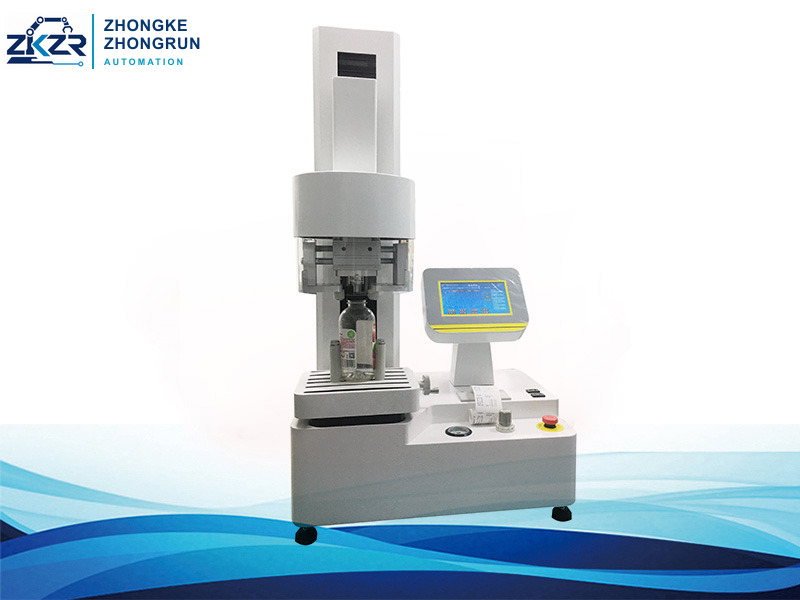
Automatic Cap Torque Tester
Automate opening and locking torque measurements on container closures.
A fully automatic cap torque system for repeatable opening and locking tests on bottles, nozzles, tubes and child-resistant closures.
Reference unit price / AvailabilityUSD 11,000 per system / In stock
01 / Application
Workflow and key features
The NLY-20A automatically grips and rotates the closure while recording the torque profile. Automated motion reduces operator influence and supports higher-throughput quality control of pharmaceutical, beverage, cosmetic and household packages.
- Automatic clamping and rotation reduce operator-to-operator variation
- Opening and locking torque modes support line and laboratory workflows
- Torque curves provide more diagnostic value than peak force alone
- Supports bottles, nozzles, tubes and configured child-resistant caps
- Stored results, printing and data interfaces support traceability
02 / Public technical data
Reference configuration
Published values describe the referenced standard configuration. The formal quotation confirms the selected range, fixtures, utilities, method edition and supplied documentation.
- Torque sensor capacity
- 10 Nm
- Torque accuracy
- +/-0.5% of indication from 10-100% of sensor capacity
- Torque resolution
- 0.001 Nm
- Container clamping range
- 5-200 mm diameter
- Closure clamping range
- 10-110 mm diameter
- Container height
- 20-400 mm
- Specimen clamping and rotation
- Manual clamping; motorized rotation
- Automatic opening/closing torque
- Up to 5 Nm; other ranges available
- Required air supply
- 0.7 MPa, user supplied
- Data capacity
- Up to 50 groups, 6 specimens per group
- Machine dimensions
- 550 x 385 x 1000 mm (L x W x H)
- Electrical supply
- 220 VAC +/-10%, 50 Hz
Test-method referencesReviewed for the selected applicationConfirm on request +
The public source material does not identify a reliable model-specific method list. Send the required method or acceptance procedure and we will confirm compatibility, fixtures, software and supplied verification documents before quotation.
- Material structure and thickness
- Sample dimensions
- Required test method
- Expected force, pressure or barrier range
Configuration boundary
Request formal configurationThe quoted configuration remains the controlling specification.
Published values describe the referenced standard configuration. The formal quotation confirms the selected range, fixtures, utilities, method edition and supplied documentation. Delivery scope, warranty, lead time, calibration evidence and overseas service are stated in the formal offer.